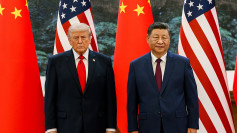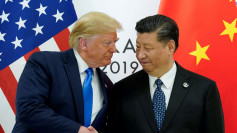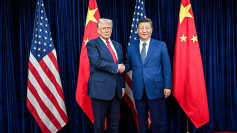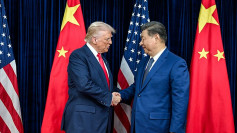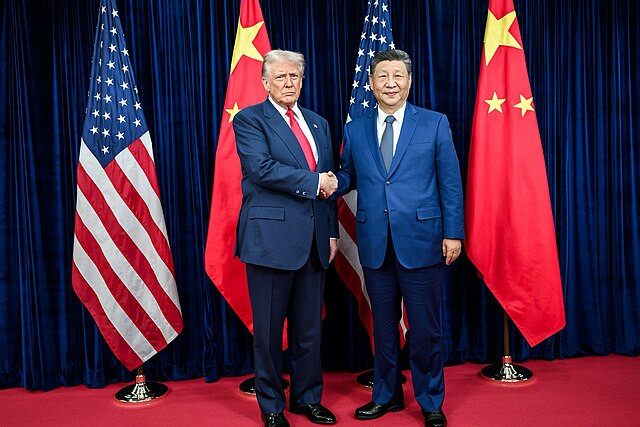
Donald Trump arrived in Beijing on Wednesday for his first visit to China in nearly a decade, opening a closely watched summit with Xi Jinping at a moment when tensions over trade, Taiwan and the Iran war are colliding with a fragile attempt to stabilise relations between the world's two largest economies.
The two-day state visit marks Trump's first return to China since 2017 and comes as Washington and Beijing navigate a far more confrontational geopolitical environment than the one that defined his earlier presidency. Tariff disputes, military competition in the Indo-Pacific and diverging positions on Iran have reshaped the relationship into one increasingly characterised by strategic rivalry rather than cautious engagement.
Before departing for China, Trump sought to project confidence about his relationship with Xi while also warning Beijing against any move toward Taiwan. "I think we'll be fine," Trump said. "I have a very good relationship with President Xi. He knows I don't want that to happen."
The summit itinerary reflects the symbolic weight both governments are placing on the visit. According to the Guardian, Trump is scheduled to attend a formal state banquet, private meetings with Xi and a tour of the Temple of Heaven, the centuries-old imperial religious complex long associated with dynastic legitimacy and Chinese statecraft.
The visit unfolds against the backdrop of the ongoing US-Iran conflict, an issue that has complicated already tense relations between Washington and Beijing. Chinese officials have publicly positioned themselves as advocates for regional stability while resisting pressure to fully align with the American approach toward Tehran.
The Guardian reported that Chinese Foreign Minister Wang Yi recently hosted Iranian Foreign Minister Abbas Araghchi in Beijing and defended Iran's right to develop civilian nuclear energy. Trump, however, dismissed the idea that Washington required Beijing's assistance.
"I don't think we need any help with Iran," Trump told reporters before boarding Air Force One. "We'll win it one way or the other - peacefully or otherwise."
Even so, Trump avoided directly attacking Xi over Beijing's ties to Tehran. He instead described the Chinese leader as "relatively good" during the crisis and insisted the United States had "Iran very much under control."
Analysts say the tone of the summit reflects how dramatically the balance of power between Washington and Beijing has shifted since Trump's first China visit. In comments cited by the BBC, Ali Wyne said Beijing no longer feels compelled to prove parity with the United States because China is now broadly viewed as a geopolitical equal.
"I think that the Chinese delegation understandably expended an enormous amount of diplomatic effort trying to convey the impression that President Xi was President Trump's geopolitical equal," Wyne said. "What I find striking is that this time around that assertion isn't necessary on the part of Chinese."
Wyne added that Washington increasingly sees China as a "near-peer" competitor and described the country as "arguably the most powerful competitor that the United States has confronted in its history."
Beyond the formal diplomacy, the visit has also drawn attention inside China, where public attitudes toward the United States and Trump remain deeply mixed. Interviews published during the summit captured both frustration and admiration among ordinary Chinese citizens reacting to America's global role and Trump's leadership style.
"He doesn't care about the consequences at all," one man visiting Chongqing said of Trump. "He should know that we share the same world. It is a global village. He should not always put America first."
Another Chinese citizen, a nail technician whose investments were affected by the Iran conflict and broader economic instability, said: "I want to tell Donald Trump to stop stirring things up."
Yet admiration for aspects of American culture and education remains strong among many younger Chinese. A fashion student travelling in Chongqing described the United States as "a country full of creativity and wisdom."
"When I think about the US, I think about its liberty, and people there can find their personality and discover their potential," she said. "It's a country full of creativity and wisdom, and many Chinese young people would like to receive an education there."