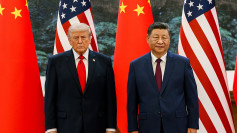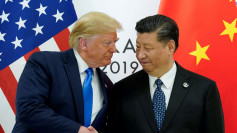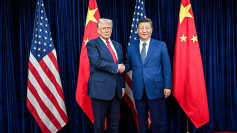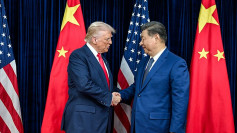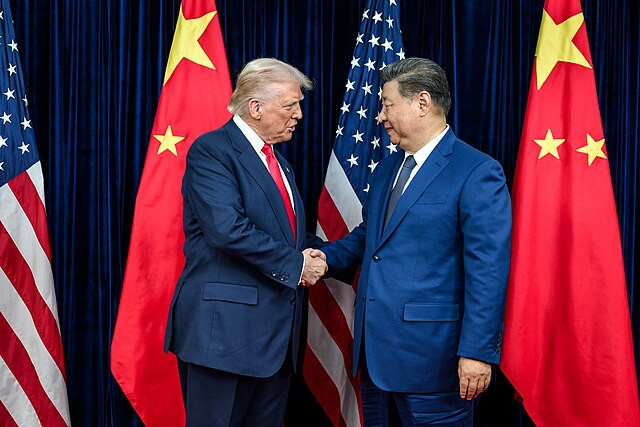
Donald Trump arrived in China this week under an unusually restrictive set of cybersecurity protocols that required senior US officials and advisers to abandon personal phones, limit digital communications and rely on tightly controlled government systems throughout the state visit.
The measures, described by security experts as consistent with longstanding concerns about Chinese surveillance capabilities, underscore how deeply cybersecurity tensions have become embedded in the broader relationship between Washington and Beijing. While trade and regional security dominate the public agenda of Trump's two-day visit, behind the scenes the American delegation is operating inside what officials view as one of the world's most heavily monitored digital environments.
According to reporting cited by Fox News, members of Trump's traveling team were instructed to leave behind their everyday smartphones and instead use temporary "clean" devices with stripped-down functionality designed to reduce vulnerability to hacking, data harvesting and electronic surveillance.
The restrictions reportedly extend beyond phones. Delegation members are also limiting laptop use, restricting access to cloud services and avoiding standard messaging platforms commonly used during international travel. Rather than relying on commercial encrypted apps or personal accounts, communications are being routed through approved government-managed channels and tightly supervised technical systems.
Former Secret Service special agent Bill Gage described the precautions as standard practice for high-level visits to China, where American officials have long assumed electronic activity may be monitored.
"China is a mass surveillance state. Briefings for US officials begin well before the president arrives, and they make clear that everything is monitored," Gage told Fox News. Gage now serves as director of executive protection at Safehaven Security Group.
The heightened security environment has altered even routine operations inside Trump's delegation. Staff accustomed to instantaneous communication through smartphones and messaging apps are instead relying more heavily on face-to-face coordination, paper briefings and secured communication hubs established by government technical teams.
Cybersecurity experts say the slower pace is intentional. The objective is not simply to prevent hacking, but to minimize the amount of sensitive political, diplomatic and commercial information potentially exposed during the visit.
Theresa Payton, now chief executive of Fortalice Solutions, said American officials are trained to operate under the assumption that both digital and in-person conversations may be observed.
"We always tell people to assume everything you say and do - both in person and digitally - could be monitored. And to conduct themselves accordingly," Payton stated.
The extensive precautions reflect years of escalating tension between the US and China over cyber espionage, infrastructure intrusions and intellectual property theft. American intelligence officials have repeatedly accused China-linked actors of targeting government agencies, corporate networks and critical infrastructure systems, allegations Beijing has routinely denied.
Those concerns have increasingly shaped the mechanics of diplomacy itself. High-level visits that once revolved largely around protocol and logistics are now planned through the lens of cyber defense and digital containment.
The Trump delegation arriving in Beijing includes cabinet officials, senior White House advisers and leading corporate executives from major American firms. Yet despite the presence of technology leaders and business chiefs, the visit is unfolding inside a communication structure that sharply limits many of the digital tools their industries helped normalize globally.